Winners of the 2026 RIAS Media Awards
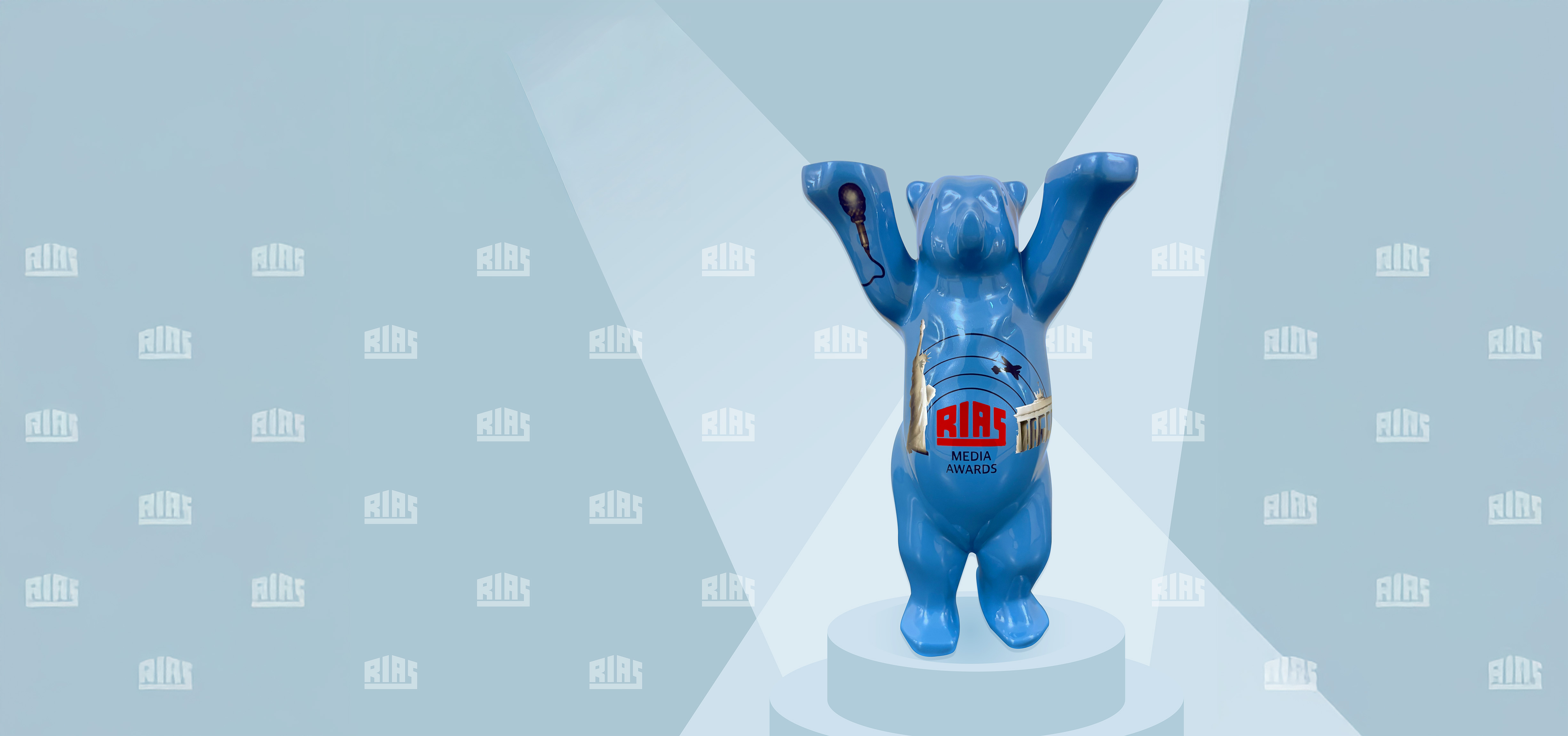
On May 7, 2026, the RIAS Berlin Commission will present the RIAS Media Awards at Berlin’s City Hall Rotes Rathaus to journalists from Germany and the United States who have addressed topics of transatlantic relevance in a particularly compelling manner in their articles and reports.
Christoph Jumpelt, Executive Director of the RIAS Berlin Commission: “The fact that we received more than 80 submissions for the RIAS Media Awards shows that the relationship between Germany and the United States plays a significant role in journalism. We foster this mutual interest year after year through our exchange programs. Here, journalists gain deep insights into political and cultural developments in the other country and can exchange views with colleagues on the other side of the Atlantic about the growing challenges facing independent journalism. I would like to thank the jury of RIAS alumni for their efforts; they did not have an easy task given the large number of outstanding submissions.”
Michael Gargiulo, anchorman at WNBC New York and chairman of the RIAS Media Awards jury: “What impressed me so much was the wide variety of this year’s winners, from young German filmmakers traveling to West Virginia to reclaim their stolen work, to American journalists seeing for themselves the rise of the far right in Germany.”
The RIAS Media Awards are presented in five categories:
The TV Award goes to Hannah Congdon, Evan Williams, Vanessa Schlesier, and Dan Edge for the documentary “The Rise of Germany’s New Right,” which aired on the Frontline program on PBS (Public Broadcasting Service) in the United States.
The jury says: The award honors an outstandingly researched and richly layered documentary that situates the rise of the new right in Germany while placing it in a broader international context. The PBS FRONTLINE production “The Rise of Germany’s New Right” offers a compelling investigation into how far-right actors have come to the brink of political power, and examines the drivers behind growing support for nationalist politics – including potential influences from Russia and the United States. The film stands out for its exclusive insights and long-term observation, as well as its remarkable access to key protagonists, including senior AfD politicians. It is further strengthened by historical context and well-founded analysis from intelligence experts, journalists, and scholars. In doing so, the filmmakers succeed in making complex political dynamics understandable. The documentary thus makes an important contribution to transatlantic understanding of current democratic challenges.
Eberhard Schade of Deutschlandfunk Kultur has been honored with the Radio Award for his feature “Germans in Texas – Bach, Beer, Business as Usual?”.
Jury decision: The radio feature “Bach, Beer, Business as Usual?” tells of Pilsener Urquell in the fridge, the sausage festival in New Braunfels, and German folk songs sung in a choir, but in between, repeatedly and very skillfully the focus shifts from the 250-year-old traces of German immigrants to the situation of those who only emigrated to the U.S. and specifically to Texas in 1989, after the fall of the Berlin Wall. In doing so, the feature takes the story to a new level: How are those faring who left East Germany for the U.S. because they followed the promise of freedom they had missed in their own country for decades? It is a mixed picture that Eberhard Schade paints for us. And he reflects it in a very personal way, with plenty of humor, and a loving, intimate view upon his protagonists. An outstanding piece of radio that shows just how intertwined German-American history is, and how deeply what is currently happening in the U.S. once again affects us as well.
The Digital Award goes to Deutschlandfunk for the podcast “The Peter Thiel Story.” The authors are Klaus Uhrig, Christian Schiffer, Jasmin Körber, and Fritz Espenlaub.
Jury comment: The Peter Thiel story explores the life and rise of most secretive and most powerful figures in the American far right. Peter Thiel, born in Germany, is the mastermind behind the cultural shift to the right in the United States, and one of Donald Trump’s most important supporters. In this six part Podcast, we learn about his unusual childhood, his elite education and how he came to found some of the best known names in the tech world: PayPal, Facebook and Palantir. We see that he did not just become rich but powerful. Some people fear his views are undemocratic: support for right wing populism, far less rules for corporations and maybe even a future under a ” techno-oligarchy”, where tech firms can influence government policy.
Ariel Plotnick and Emma Talkoff of The Washington Post have been honored with the RIAS Fellow Award for their report “Should Germany ban its far-right party?”
The jury says: Washington Post journalists Ariel Plotnick and Emma Talkoff deliver a thorough, intimate portrait of Germany’s right-wing populist party, the AfD. The podcast examines mounting calls to ban the AfD following an exposé of a secret meeting in which party members discussed plans to expel immigrants from the country. Grounded in strong historical context, the reporting combines sweeping political analysis with sharp boots-on-the-ground journalism. The podcast also draws compelling parallels between the AfD and the MAGA movement in the United States. With a well-curated range of voices — from ordinary voters to AfD members themselves — this is essential listening for anyone seeking comprehensive, well-sourced reporting on the party.
And the RIAS Grand Prize goes to the team of authors Igor Plischke, Christopher Zwickler, Anika Mellin, and Hannes Beßler for the ARD/MDR co-production “The Talented Mr. F.”
Jury decision: “The Talented Mr. F – The Hunt for a Film Thief” deserves the RIAS Grand Prize because it offers a fresh and highly relevant perspective on German-American relations—not through politics, but through creativity, copyright, and the power dynamics of the digital age. The film reveals how deeply interconnected both media landscapes are, and how vulnerable creative work has become in a globalized, online world. At the same time, the documentary gives a voice to the rightful creators. Julius and Moritz represent a young generation of filmmakers whose work deserves recognition and protection. Honoring this film also means restoring visibility and acknowledgment to those who were deprived of it. What makes the film particularly outstanding is its storytelling: the investigation unfolds like a thriller, closely following its protagonists with emotional depth and narrative tension. The audience is drawn in, rooting for them every step of the way. Ultimately, the film transcends its individual case, raising universal questions about truth, ownership, and justice in the digital era.