
Claudia Roth speech at the RIAS Media Prize Awards ceremony
June 5, 2022
Claudia Roth speech at the RIAS Media Prize Awards ceremony
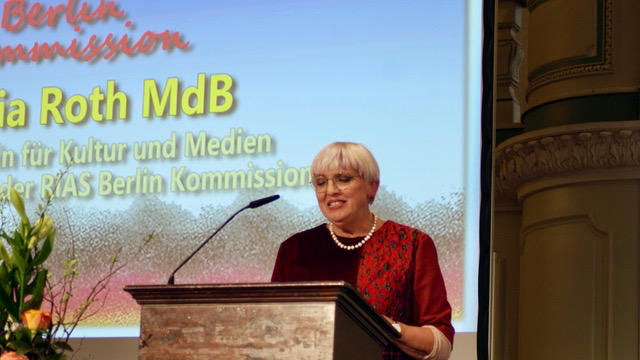
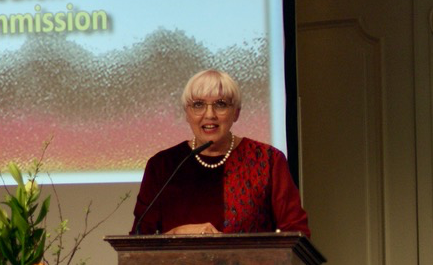
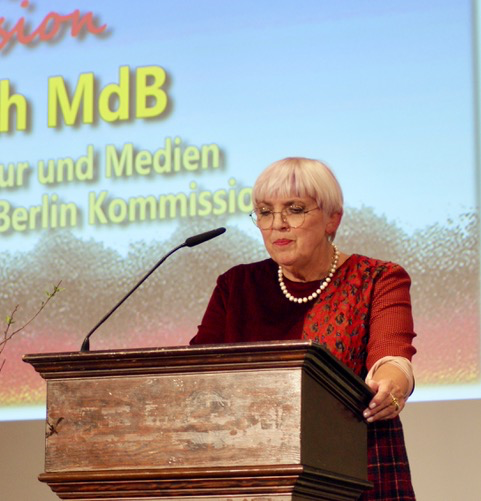
Germany’s Culture Minister Claudia Roth, who is the honorary co-chairwoman of the RIAS Berlin Commission along with Ambassador Amy Gutmann of the United States, gave a riveting speech on June 2 at the RIAS Media Prize Awards Ceremony. Roth, a member of parliament in the Greens party, paid tribute to the history of the RIAS radio and TV (Radio in American Sector) — as well as the American-style swing dance band playing, the Swingin’ Hermlins. The RIAS Berlin Commission was created 30 years ago by the German and United States’ governments as a non-profit binational organization to keep alive the spirit of the Cold War-era broadcasting company. RIAS went off the air after the peaceful conclusion of the East-West confrontation during the Cold War and some
historians said RIAS played a role in helping to overcome those divisions.
“I am glad to be here tonight, even if only as a fleeting guest. But I certainly did not want to miss the moment to congratulate the award winners, to thank you for your work, which is so important for democracy, and to introduce myself to the Commission, of which I am now the honorary chair – together with you, dear Amy, which I am particularly looking forward to.
If something has grown, it is because it has taken root. This is also true for institutions from time to time. They grow together with the task and the people for whom they were made. They become indispensable. RIAS, the radio station in the American sector, was such an institution, more than a medium in the Cold War and more than a radio station. RIAS was, no, RIAS is a Berliner.
For a Berliner whom the Berliners themselves have chosen to be a Berliner is immortal. For that there are – Ernst Reuter, Marlene Dietrich, Willy Brandt, David Bowie – not many, but some role models!
So today we are not only celebrating the winners of the RIAS Media Prize. We are celebrating the idea that has remained: “A free voice of the free world”. This is what the RIAS-Berlin Commission was founded for 30 years ago. It has worked for this in three decades, with exchange programs and fellowships, with encounters, discussions and friendships.
We have reason to celebrate this idea. We should celebrate it, in the great contributions of the laureates! We should celebrate it, because a free voice in a free world is the condition for our democratic culture.
And for this very reason we should defend it where it is threatened – there is also reason to do so. Because thinking about the freedom of the word at all is a challenge at this time. The word itself is free; it gives everyone who uses it the freedom to use it as he pleases. Lying, too, is not subject to any fundamental prohibition.
That is why, I think, it has rarely been more important than today to understand how propaganda works. I deliberately do not say how it “functions,” because it works in very different ways, it is nimble, it works with the means of its time. It is a tactician. And if it works with supposedly clumsy means, that doesn’t mean that the technique it uses is also clumsy.
In our post-postmodern world, which is so confusing and complex, in which for so long one crisis follows another, one catastrophe follows another, it is not a matter of putting a lie into the world and then reproducing it again and again.
The propaganda we are confronted with today works with countless half-truths, with different versions of one and the same story. And this cacophony has only one goal: to make us believe that we cannot know anything, that no source can be trusted. We are supposed to distrust each other.
That’s why the work of journalists, is your work so important, indeed so absolutely indispensable. It is you who inquire, who question, who use your knowledge and experience to tell us what is happening and to classify what is difficult to understand.
Journalists are fallible too, yes. But to declare them lemmings in the mainstream follows exactly the intention I just described. The intention of fomenting distrust. Because without trustworthy reporting and commentary, we remain disoriented in a globalized world with so many crises. Without trust, there can be no democracy.
RIAS was also distrusted. I quote: “But you were an American-funded program. Was there freedom of speech?” Egon Bahr, editor-in-chief of RIAS in 1953, was asked by Deutschlandfunk Kultur in 2006. Or was the “free” word dictated to the station in the end?
Bahr replied that his colleagues at German stations envied him. I quote, “You can say whatever you want at RIAS; we have to be considerate of our supervisory bodies.” The only restriction, Bahr said, was that “we were not allowed to say that the American president is an idiot.”
In the time of its existence, RIAS had no occasion to do so.
We hear lies and half-truths in many languages, Russian, Chinese, even German and American English. But the idiom is the same: an inhuman and democracy-despising “Putinesisch” and “Trumpistisch”!
We have the duty to defend free voices for a free world.
And we want to do it. We want to do it directly and unbureaucratically by facilitating the entry and stay in Germany of persecuted and fled journalists, cultural workers and scientists from Russia and Belarus together and in coordination with the Foreign Ministry and the Ministry of the Interior. It is these voices that we hope for. And it is these free voices that we can hope for.
And we want to do that. We want to do it directly and unbureaucratically by making it easier for persecuted and fugitive journalists, cultural workers and scientists from Russia and Belarus to enter and stay in Germany, together and in coordination with the Foreign Ministry and the Ministry of the Interior. It is these voices that we hope for. And it is these free voices that we can hope for.
That’s why I want to put this topic on the agenda of the G7 Conference of Media Ministers in Bonn. We have to agree on it, because the propaganda war, like the real, cruel and brutal war against Ukraine, threatens democracies as forms of state and society – not only where there is already shooting. It threatens the free world.
In conclusion, I want to pick out just one of the many historical moments that RIAS not only reported on, but in which it itself made history. And I want to use it to remind ourselves of our duty not to abandon people who are being forced to give up their freedom and independence.
We ourselves, this city, were once in such a situation. The fate of 2.2 million Berliners depended on the help of the Americans, on their willingness not to give up the free part of Berlin. RIAS broadcast from the beginning of the blockade until its end, to which it contributed.
Today we have the duty to stand by the people of Ukraine.
Thank you all very much!


