
Impressions of American journalism students after their 3-week fellowship to Germany
July 17, 2023
Impressions of American journalism students after their 3-week fellowship to Germany
Here are some impressions from 13 American journalism after a three-week fellowship with the RIAS Berlin Commission to Berlin, Dresden, Magdeburg, Erfurt, Leipzig and Hamburg from June 18 to July 8, 2023. The goal of the ERP program, which was created with support from a grant from the Economy Ministry, is to expand horizons, help connect young American journalism students with their peers in Germany and help aspiring journalists in both countries learn more about journalism training in each others’ countries.
Abby Bammerlin, Miami University, Oxford, Ohio
I´ll remember my time in Germany and on the RIAS program not by the places I went, but by the people we met and the stories they told. This experience allowed so much cultural exchange between Germans and Americans and I’ve learned so much about the German government, international politics and media. Our discussions with German journalists and politicians led us all over the map. We talked about the rise in right-wing parties and extremism across Europe, Germany’s leadership in the fight against climate change, the impact of free healthcare and education, and how the separation of East and West changed the landscape of German politics and society. Every conversation was more insightful than the last as we grew to understand more about Germany and the challenges it faces as a nation. Now that I’ve returned home, I’ve begun looking at the U.S. in a different way. I see how the U.S. makes decisions that will impact the world. I couldn’t be more grateful to have had this experience and to have gained a new perspective.
Alicia Clanton, Elon University, Elon, North Carolina
I was never able to fit a study abroad program into my college schedule, so I was extremely grateful to embark on this experience right after graduation! It was enlightening to learn how the news operates in Germany compared to the US, and to compare the national discourse over gun rights, environmental protection, and how to remember and teach dark histories. All the while, I built friendships with young journalists from all over the U.S. This has been an excellent opportunity, and I look forward to applying what I learned in my career.
Samantha Morris, Arizona State University, Phoenix, Arizona
In the East German city of Dresden, the triumphant architecture of the Frauenkirche (Church of Our Lady) was overwhelming. It now stands as a symbol of peace and reconciliation following its 1993-2005 reconstruction, once reduced to a massive pile of rubble after being bombed during WWII. Sitting in the upper pews of the church, I couldn’t help but feel choked up. You are so close to the history, the dread, the pain that war brings. And as blood continues to shed in Ukraine, it’s a even more poignant reminder that peace is a fragile thing. This is just one of the several unforgettable experiences that have been cemented in my mind by the wonderfully gracious speakers that presented to us. On a RIAS trip you won’t just be transfixed by the pastel walls and arches in the grand Church of Our Lady, or wonder at the variety of paintings preserved on the former Berlin wall’s East Side Gallery. You will hear from the experts themselves, the artists, the politicians and the journalists, many of whom were there for it all. Above all you have a front row to ask questions. In a RIAS program you have access, and in journalism access is everything. I have to thank our director Erik Kirschbaum, and all of the speakers for all their time and patience on this whirlwind of the last three weeks. I also now share this experience with 12 other young journalists forever changed as we move into our careers together. Thank you to all!
Pacey Smith-Garcia, Arizona State University, Phoenix, Arizona
After three weeks in Germany I discovered many aspects of German media and culture I had previously never known about. German media is required to provide coverage for the Sorbs and to provide media in their language. In the U.S the government provides very little for communities that exist outside the mainstream language and culture to establish and maintain media. At the same time German culture of remembrance for its past atrocities stands as a near opposite to the U.S. The U.S government has worked hard to ease its past crimes let alone make them as public as a conversation in Germany. Much like the Sorbian media this culture of remembrance is seen as a good thing by a majority of the population. I feel like these two things can serve as important lessons to take back to America. These will hopefully impact my career and the communities I serve.
Litzy Silos, University of Oklahoma, Norman, OK
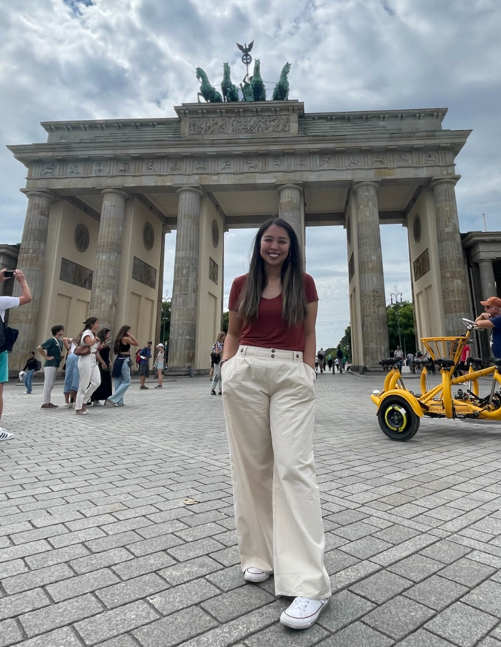
I never pictured myself going to Germany as a college student, as my career ambitions lie elsewhere. Nonetheless, having participated in the RIAS program provided me with the opportunity to visit so many museums, learn the significance the media has on the lives of Germans today, and listen to politicians from different parties speak about what they represent – all in the span of three weeks. I might have only gotten a snippet of one of these highlights as a tourist; with RIAS, I was able to do that and more. I’ll never forget, and will appreciate in particular, the days we had with a former Stasi prisoner– a current historian willing to share his story with those who want to listen. I respect that Germany’s history is not forgotten. And it’s not just one ‘history’, but all the histories. I also appreciated looking at the immigration issue miles and miles away from where I was born. In this sense, it provided me with the idea that no one country or continent handles the situation ‘better’ than the other. It’s all a matter of seeing the picture with a new lens. I came into Germany knowing there was a wall, but that was all I knew–that it was a wall. Now I know that on one side of the wall, people were spied on, and it makes sense why the country has the privacy laws it has today. It makes sense to me, why in Germany, a monthly fee is placed in each household for public broadcasting. You don’t have to agree with how a country is run, but I urge you to take a look into another nation’s history and current life, especially if you want to become a journalist. RIAS Berlin Commission, thank you for the opportunity, to everyone else who contributed to this experience, thank you for your time and your insights.
Jaqueline GaNun, University of Georgia, Athens, Georgia
Before this trip, I had never heard of Erfurt or Magdeburg. It certainly would never have crossed my mind to travel to either city. After spending three weeks in Germany through RIAS, I can say one of the most rewarding aspects of the program was the diversity of cities we visited. We met people with such varied upbringings and career paths that contributed to our understanding of what it means to live in Germany both historically and today. I will never forget our conversations with Peter Keup about his experiences in the GDR, or Kani Alavi welcoming us into his studio. Being a journalist is about discovering and sharing people’s stories; to do that, you need to explore and learn about the world. This program helped me do that.
Arine Mkhitaryan, University of Oklahoma, Norman, Oklahoma
“The world is closing in. And did you ever think that we could be so close like brothers?” Communism and Capitalism, East and West, two worlds that got united with the fall of the Berlin Wall. What could be more iconic than exploring international understanding in Germany? Maybe singing “Wind of Change” in East Germany with East Germans, fully experiencing what the fall of the wall could feel like? Sam told me CIA was involved in the process of writing this song, but my idealistic self will choose to ignore that information. The wind of change hit me in Germany during the RIAS exchange program for students. I realized on the first day of the program: I am the collective of East and West. I grew up in the East bloc, but I was representing the West. What kind of Stasi spy was I? Of course, I am not a spy, but the load of information I received could definitely satisfy any spy. Germany’s past shaped its collective way of decision-making and emphasized the importance of freedom of speech and media. People there know the essence of one voice and how individuals matter for the good of the collective. The media can never be perfect, but in Germany, I saw the model of journalism closer to perfection. Understanding Germany became easier when talking to the people that have some kind of influence on the public. Every single person we talked to influenced me as well in different ways. Starting from media people and politicians, ending with activists and musicians that touched my soul to the point of tears. I became addicted to learning, addicted to stories, addicted to people and finally, addicted to asking questions. I also became addicted to the group of like-minded peers, who became a safe space and support system for me and for each other. It made it easier, that everybody had the same goal: broaden horizons, challenge and being challenged. To conclude, I want to make sure everyone understood: I am not a spy, I am just a sample of how Westerners and Easterners can actually be close like brothers. Thank you!
Isabella Gamez, University of Arizona, Tucson, Arizona
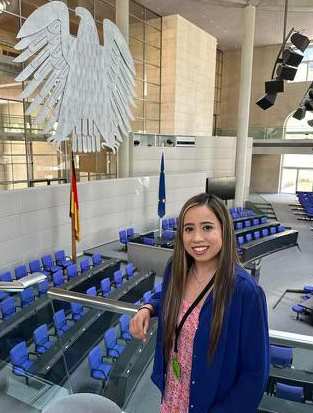
One word stands out when I think of the German political system. That is democracy. Learning about Germany’s political system and comparing it to America’s made me realize just how important the word “democracy” is to Germans. There is a deep appreciation of this form of government that you don’t often see in the U.S. Visiting the Reichstag building, I walked around the glass dome and admired the transparency of the government in the policies they make for the people. On my way home, I recalled this memory as well as many others I made during the RIAS program. I’ll be forever grateful for this experience that I’m glad to call my first trip to Europe.
Linus Dentel, Ithaca College, Ithaca, New York
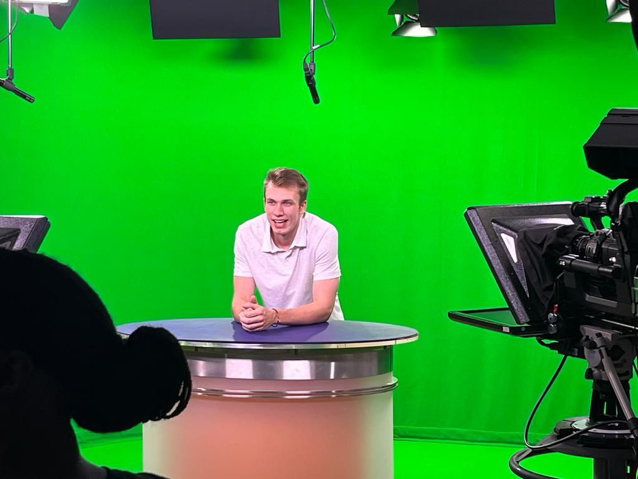
Over the last three weeks, I was fortunate to hear modern perspectives from individuals with great poise and intellect. From the open-minded group of students willing to discuss German nationalism (and it’s many layers), to the former Stasi prisoner who shared his life story, or to meeting an East Side Gallery artist who broke barriers by preserving them with art; each shared their story willingly. To me, these stories are the building blocks for the continued process that is reunification between East and West Germany. From the eyes of a student, Berlin, Dresden, Erfurt, Magdeburg, Leipzig and Hamburg were all new places for us to explore each with their own unique characteristics. From the eyes of a journalist, these cities offered something else: division. We observed during this program that Germany is a divided country just like the United States. Speakers like Andreas Weise, Julius van de Laar, Olaf Kische and Katharina Hamberger are among the many forward thinking people we met who recognize that without change there cannot be progress. Lastly, this program gave me the opportunity to forge new relationships which will last a lifetime and for that, I am grateful. Thanks to RIAS, I feel it’s fitting for me to end this by saying, “Ich bin ein Berliner.”
Julietta Bisharyan, University of California, Berkeley
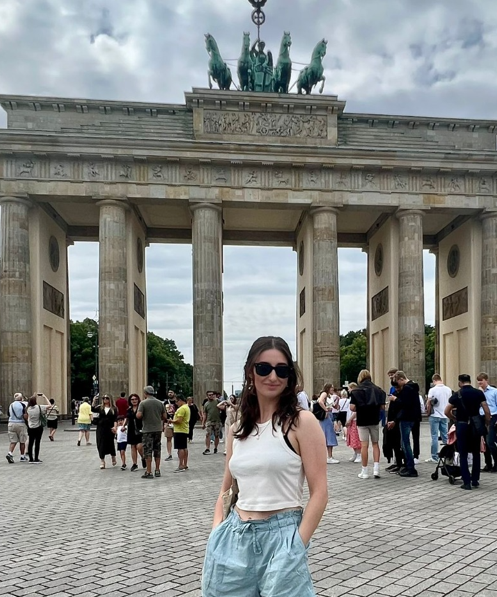
Over the past three weeks, I’ve learned a lot. While being an American affords numerous privileges, it’s crucial to understand that our country is far from perfect. Witnessing the Germans’ genuine commitment to addressing climate change only highlights the frustrations I feel about how this issue is handled back home. From free healthcare to tuition-free education, Germany seems to have found the right approach to many societal aspects. It’s a place where tangible progress is evident, which is something I wish I could confidently say about the United States. Above all, I deeply admire Germany’s openness regarding its dark history –– something that many other nations have yet to take the first step in. Everywhere you walk, there’s a reminder of the past and how it impacts the present. As I leave with 5 euros in my wallet, I carry with me not only fond memories but also many future story ideas that have been inspired by this transformative experience.
Mary Leopoldo, University of Arizona, Tucson, Arizona
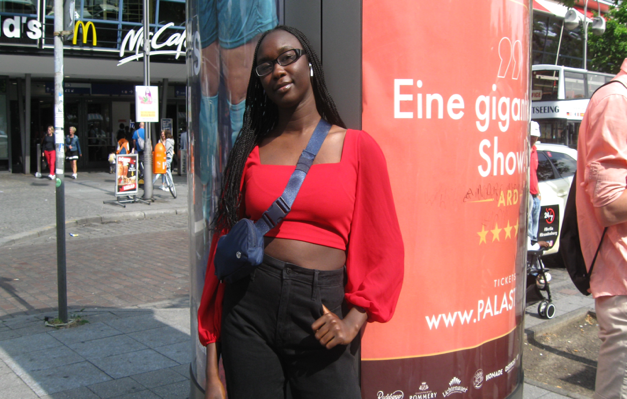
The past 3 weeks have been very informative. Learning and getting a deep understanding of Germany’s history and also how the government works. Visiting the Jewish memorial really puts everything to perspective and makes you appreciate highlighting your country’s wrongdoing and working towards better. Also meeting with the different political leaders helps you get a better understanding of what they believe and in what way they want to make Germany a better country not just in Europe but also around the world. Overall, I highly recommend this for anyone interested in how big of an impact journalism had during the cold war.
Daisy Tanner, Arizona State University, Phoenix, Arizona
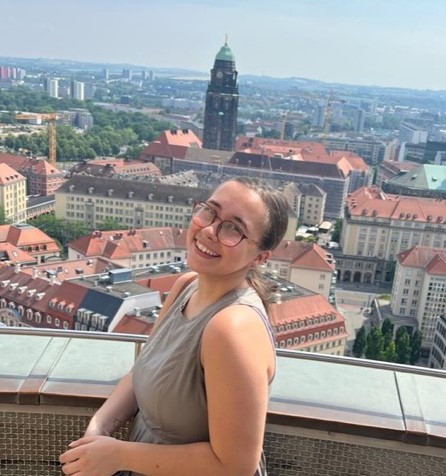
I grew up learning about a wall that divided a nation. I was taught about the differences between East and West Germany and watched videos of the wall falling. What the American education system failed to teach me was the negative impacts left after the wall fell. On this trip I talked to several people who grew up in the GDR, all of whom had a different experience and perspective. I met with a former Stasi prisoner, people who were proud to have served in the GDR military, and even to an East Side Gallery artist who painted the different emotions he saw on people’s faces as the wall came down. Talking to real people about their experiences and walking through multiple Eastern cities gave me a deeper understanding than I could have gotten from pictures in a textbook. I got to see how almost 30 years later the country is still trying to bridge the gap between the former East and West. The RIAS Berlin Commission gave me a glimpse into another world, one that I would not have been able to see on a typical tourist trip. The cultural experience and understanding I gained in just three weeks some people don’t even experience in a lifetime. I will forever be grateful for the opportunity that this program provided.
Jarred Watkins, Miami University, Oxford, Ohio
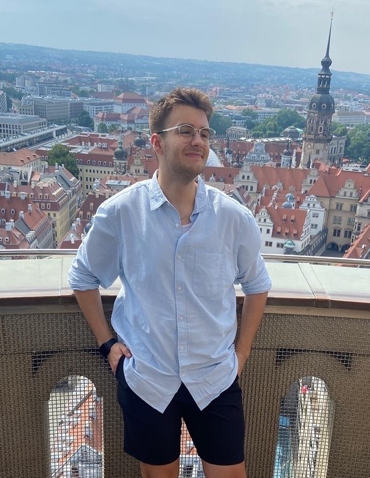
Exhausted from 24 hours on a plane and running between gates left me with only one thing to say to my father when he picked me up from the airport: “Germany, no, RIAS, has forever changed my perspective on what it means to be a democracy. We are not doing it wrong, but they are doing it right.” Even after my 13-hour slumber and morning coffee, what I told my father that night in the car stood true. We spoke to members of parliament, journalists, students, historians and even former Stasi prisoners who all spoke on what it meant to live in a divided country before it was a united democracy. We learned about the structures and systems of power both before and after reunification and the issues and successes of both. Truly an eye-opening experience.


