
WUSA9 anchor Larry Miller talks about changes in USA with Covid-19
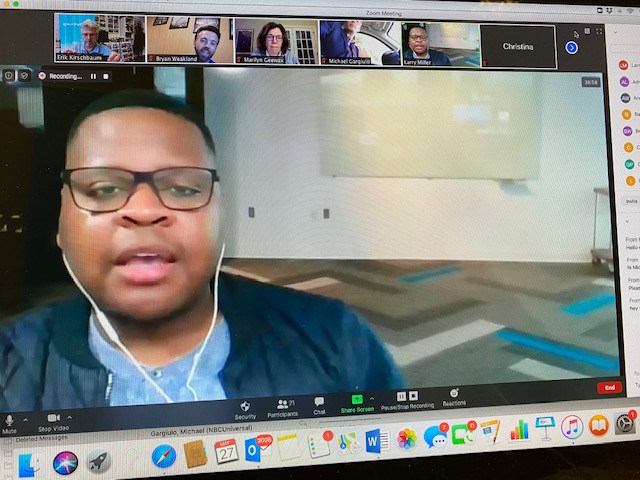
Larry Miller, an anchor at WUSA9 TV in Washington DC and a RIAS alumni, said that the coronavirus pandemic has created a lot of new challenges in his job and that there has been a lot of stress involved in covering the news. But he said it has also been an extremely interesting time in his career, which began in Oregon and included a stop in Alabama before he ended up in Washington DC six years ago.
“All interviews have to be done by zoom and Skype and FaceTime or telephone,” Miller told a group of 21 RIAS alumni and candidates in a videoconference. “Our job is about interviewing people. Zoom and Skype have made it convenient and have allowed us to maintain safety. But you certainly lose that human connection that makes storytelling so great. Not being able to talk to people face to face — often there’s texture and color in an interview that’s lost when you don’t get to have that human connection because you may not always understand through body language what the follow up question or comment on those things is that make people visibly uncomfortable and to then go back to that and ask ‘Why do you feel uncomfortable when I ask you that?’. You can’t comment on those things that might make people uncomfortable. I can’t ask those things because I can only see their neck and face. Those things have made it challenging in some respect, but I think we’re doing the best we can navigating that.”
Miller, who made an interesting video for future RIAS participants after his fellowship in 2019, said that viewers seem to be hungry for non-Covid-19 news at times and pointed out that ratings at his station have risen by 250%. “Ratings are through the roof. We’re seeing a substantial increase in viewership. That’s great for job security,” he said. “People want context.”
Miller, who was nominated for an Emmy award this year, said he thinks the media have been slow off the mark to report on the impact on small business from the coronavirus crisis that has sent the unemployment rate soaring and put strains on many companies, large and small. “I think the story that a lot of people are missing now centers on the business fallout that we’ve had from this. We’re starting to see a lot of businesses, especially minority-owned businesses, not getting access to loans. One study put it that close to 95% of minority-owned businesses applying for these loans are not getting them. There is this economic small business story that we’re not paying attention to.”
Miller said it has been an extraordinary period for journalism. The political divisions in the United States have started to have an impact on the coronavirus discussions, he said.
“It’s been stressful but it’s also been interesting,” he said. “And I think we are just trying to be responsive to the viewers in the best way we possibly can and we’re trying to be respectful as well.”


