
Beyer says more connecting Germany and US than dividing it, in RIAS Zoom Talk
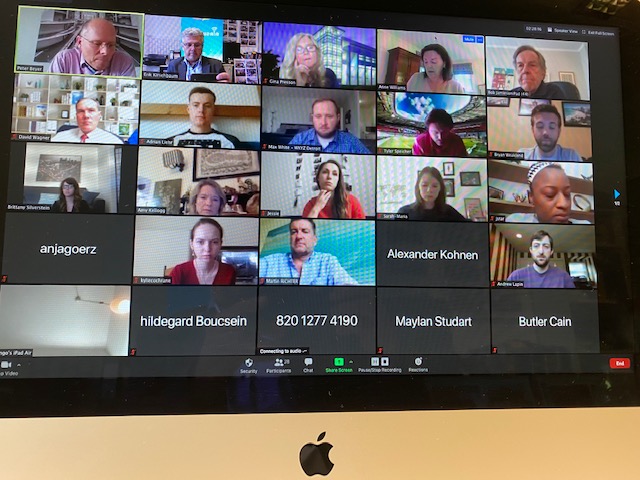
The German government’s transatlantic coordinator, Peter Beyer, said in a meeting with German and US journalists that there is far more that connects the two countries than divides them, and expressed his hope that there could one day be a comprehensive free trade agreement between the United States and the European Union. Beyer, who is also a RIAS Berlin Commission board member and travels to the United States on average once per month, said he was disheartened by recent opinion polls showing that German views of China are improving while opinions on the United States are declining.
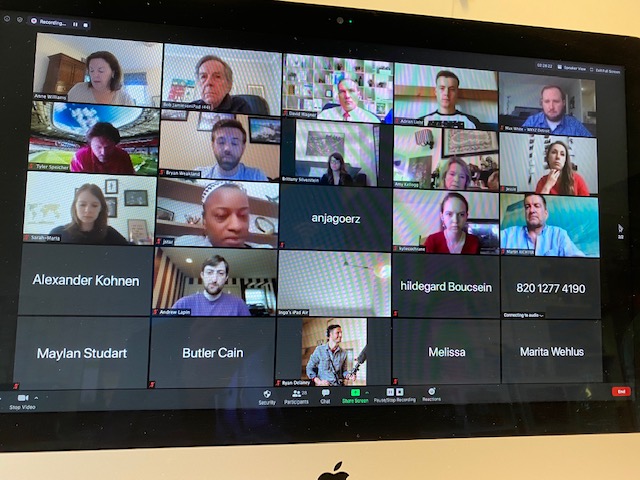
“My transatlantic heart is bleeding,” Beyer said of those surveys in a virtual Zoom talk with about 32 RIAS Berlin Commission alumni and candidates for future programs. “There is more that unites us than divides us. We have to see how we can overcome some of the problems.”
Beyer, an enthusiastic supporter of German-US relations, has had to put all that travel to the
United States on hold since March. He said he is not sure whether conditions will allow him to travel to the United States again this year. He said he hoped talks for a free trade agreement could start as soon as possible.
Beyer is a member of the German parliament in Chancellor Angela Merkel’s Conservative party and also answered questions from the RIAS alumni about how Germany has managed to get through the coronavirus crisis so far. He said there was likely a combination of factors that helped the country, including Merkel’s leadership.
“Angela Merkel was a good crisis manager before and proved to be the case this time as well,” he said, referring to how Merkel led Germany through the 2008 financial crisis and the euro-zone currency crisis that followed in the ensuing years. “The biggest reason is that the Germans, by the vast majority, were living by the rules. They realised it was a big emergency and played by the rules for a long time. That’s probably the most important contribution.”
Beyer added: “There is no easy answer for that. We’re far from being out of it. We had a lot of intensive care units, more than we needed it turns out. We were well-equipped. We were not well- equipped with masks. We found a good proportionate way of restricting freedom rights and with lockdown restrictions. I think it was a very good format. The federal government and the 16 regional governments coordinated their moves. It was very calmly managed. The lockdown restrictions were not as harsh as in other parts of the world. We’re having modest lifting of the restrictions now. It was time we started lifting the restrictions.”
Beyer said he was unsure how the coronavirus crisis would change the transatlantic relationship, but reckoned it would have an impact: “I can’t say right now how much the pandemic is changing the transatlantic relations. It seems to me the situation will leave footprints and make changes that will be there in the transatlantic relations for some time.”
Beyer also noted the US election campaign this year is a lot different than in the past years due to the pandemic. He said that in normal times, the high unemployment level and difficult economic situation in the United States would be a problem for the incumbent. But he said that this year, with the pandemic looming, the situation is far from clear. He said it was important for Germans to keep in mind the November election would also be for Congress and not just a presidential race.
“We have a strong interest in multi-lateralism. We sometimes criticise the U.S. administration. We love the United States. I think everyone in parliament and the federal government knows how important the American friends are for our future, for our sheer existence and for our prosperity. But sometimes these days our American friends give us a headache when we oftentimes seem to be aligned and with similar interests, such as in Iran, but we totally seem to disagree on the way to reach these aims. We have similar interests with China. We sometimes take different approaches.”
The next RIAS Zoom talk will take place on Wednesday, May 20 at 1600 Berlin time with WNBC anchor Michael Gargiulo, who will talk about how the pandemic has changed both his life and news network in New York. German medical doctor Christoph Specht of NTV and RTL networks will speak on Tuesday May 26 about Germany’s handling of the pandemic and RIAS alumni, Larry Miller, will talk about his work during the coronavirus crisis as an anchor at WUSA9 in Washington DC.


