
German journalists’ impressions of USA after 3-week exchange program
A group off 10 German journalists spent three weeks in the United States in March, learning more about the political, economic, cultural aspects as well as sports. They were in Washington and New York for one week each and then spent a third week visiting small American radio and TV stations across the country. Here are their impressions of their journey:
Nazan Gökdemir, ZDF Arte
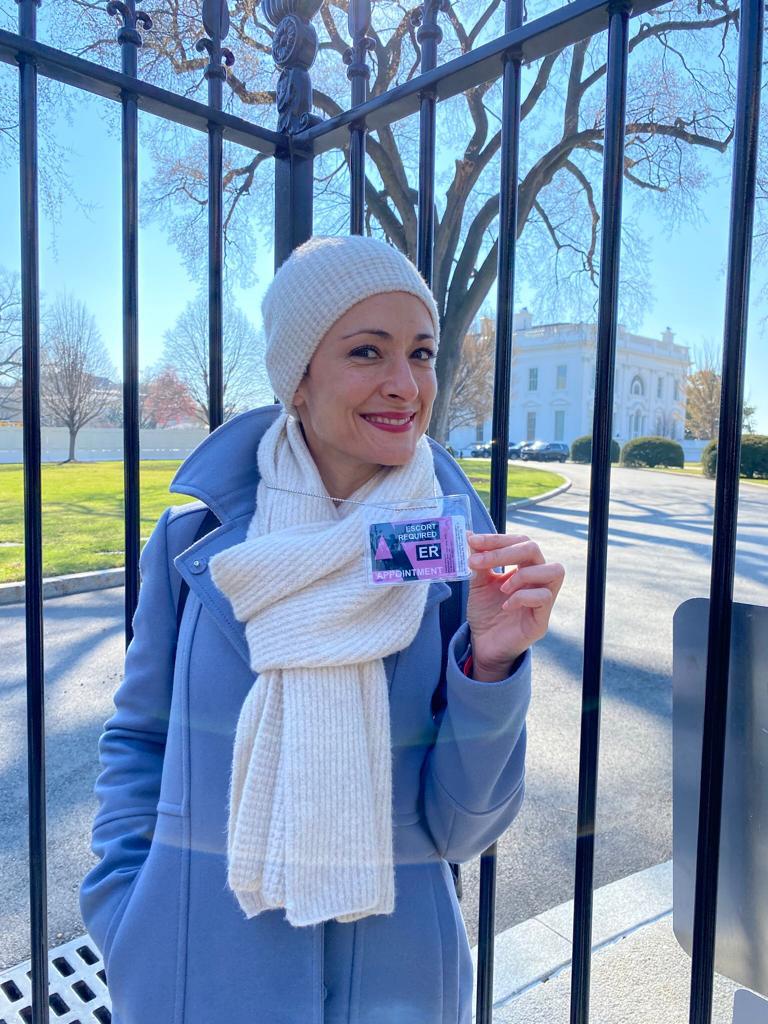
What a fantastic and unforgettable experience! One week in Washington, one week in New York. More than 35 meetings with journalists, politicians, activists, lobbyists, pollsters, a walking tour through the Hasidic Jewish neighborhood of Williamsburg in Brooklyn, a play on Broadway…My personal highlights were the visit to the White House and the Sunday Mass in Harlem. Goosebump moments! From time to time, there were also spontaneous meetings, among others with former Trump lawyer Michael Cohen. Every single encounter, every single item on the packed RIAS agenda was a unique and enriching experience. Sometimes hopeful, sometimes depressing, always impressive!
Although I have been to the USA several times, thanks to RIAS I got new insights into a torn country full of contradictions. In direct, honest and critical conversations with journalists, I became aware of how rough and tough the competition within the U.S. media landscape is and how much opinion-oriented news broadcasts can corrode trust in facts and truth and thus ultimately also pose a danger to democracy.Our educational trip was overshadowed not by Corona, as I had originally feared, but by the Russian war of aggression in Ukraine. Russia’s President Putin has not only posed new challenges to the transatlantic relationship, but also strengthened it. I think the RIAS exchange program is more important than ever. As a RIAS alumni, I am now happy to be available to our U.S. colleagues as a contact person – and to answer questions about the country, its people and its media with as much openness, enthusiasm and conviction.
——————–
Christian von Rechenberg, ZDF, heute-journal
“It’s all about people” – that was the answer of Bill Whitaker from CBS to my question about what makes his program 60 Minutes the best investigative magazine in the USA. The fact that I was able to put my questions to a top interlocutor again on day 10 of the RIAS trip had long been normal. And once again made the answer all the more valuable: It’s all about people – get to the people. That’s how I would sum up the two weeks with RIAS. We didn’t talk about things, we talked to the people they affected: with a former Republican congressman, for example, we talked about Trump and “the storm.” With the co-founder of Black Lives Matter NYC, we talked about structural racism in the US and the anger within the movement. Eye-to-eye, critical, honest, engaged.
Each of these meetings expanded my knowledge, my understanding, my image of the USA. All of the interlocutors were happy to go far beyond their own horizons with us. We were able to curiously ask ourselves about the polarization of society, unlimited freedom of speech, social peace, the future and the past of the USA.
In addition, there was a very fine accompaniment: I will not forget the church service in Harlem, nor the guided walk through the Hasidic community in Brooklyn. We even climbed the fence of the White House. This program is hard to beat in terms of content. However, it is a pick packed daily schedule that we generally walked off(!). The RIAS program is not a pleasure trip, you have to be aware of that. It is demanding and exhausting, it requires discipline and sometimes patience. If you have both, you will return home with satisfaction and an inner smile. And maybe a catchy tune by Bruce Springsteen (ask Erik for details 😊).
——————–
Katharina Hamberger, Deutschlandfunk
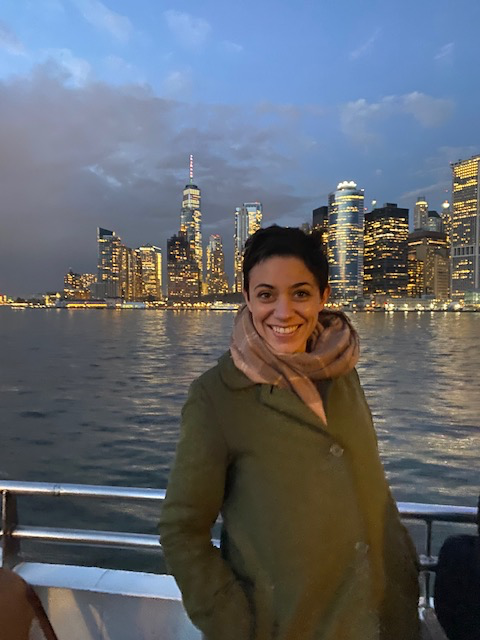
Two weeks, a thousand impressions – which have greatly shaped my image of the USA. Originally, I was supposed to go to the USA with the RIAS Berlin Commission already in March 2020, but then Corona intervened. At that time, the United States was still a country shaped by an incumbent President Trump – now we have seen what traces these four years have left behind, but also why this was possible at all. Our interlocutors, from left to right, from conservative to progressive, gave us many insights into a country that is deeply divided. They painted a picture of a society with deep rifts running through it – and hardly anyone looked to the future with optimism. We also got to know the U.S. as a country in which many of the developments are also related to history: among other things, a two-party system that makes compromises difficult and favors populism, a promise of freedom that at the same time relies so much on the self-responsibility of each individual that many fall by the wayside, an understanding of Freedom of Speech that does not even know a limit in Holocaust denial.
We also got to know a media landscape in which, on the one hand, the agencies – such as Reuters – operate, whose top priority is to be as neutral as possible. On the other hand, we learned that American media are also a mirror of society and that everyone can choose their view of the world. As a public service journalist, I particularly remember the visit to NPR, which showed me how happy we can be about our ÖRR system and not have to constantly collect donations. But we also got to know many open-minded people who were willing to give us insights that you would never get on a vacation; committed journalists who showed us the conditions under which they work, who shared their thoughts with us, who discussed things with us and answered all our questions. We were given insights into the country’s most important think tanks, which were also a challenge to us because they represented a very broad spectrum between conservative and liberal. I was also particularly impressed by the discussions with ADL, AJC and Black Lives Matter.
Of course, Russia’s attack on Ukraine also shaped the two weeks in the US. The events were a topic at almost every meeting. On the one hand, because they show once again the fragility of democracies and the ruthlessness of autocracies, on the other hand, because the EU, Germany and the USA also play a special role in this conflict – and it was exciting to hear the view on it again from another, an American perspective. It was an impressive 14 days.
——————–
Carolina Chimoy, Deutsche Welle, International Correspondent
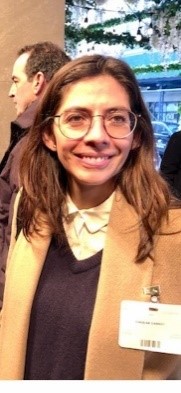
This is perhaps one of the most exciting times in transatlantic relations. The war in Ukraine has changed and accelerated many things. The struggle between democracies and autocracies has led to a turning point in transatlantic relations, which were strained by the previous U.S. administration. The United States and Germany are now more united than ever.
Having the opportunity to conduct in-depth background interviews with high-level political actors, experts and civil society representatives in the U.S. during these exciting times is a gift for any journalist. Whether it was the conversation with the president of the American Jewish Committee, who, as the son of Holocaust survivors, interestingly sees Germany as a leading power in Europe right now, or Donald Trump’s longtime lawyer, who recognizes similar traits in Putin as he did in his former client. They have all helped to sharpen the political picture on the international stage and the implications for bilateral relations between Germany and the United States.
In domestic politics, Germany and the United States also face similar challenges: growing inequality and polarization threaten to destabilize democracy from within as well. Being able to discuss these conversations and thoughts among a group of highly qualified journalists made this week unforgettable. I would have loved to have accompanied the group back to Washington. Thank you for a very enriching week in New York.
——————–
Nadine Jantz, Welt TV
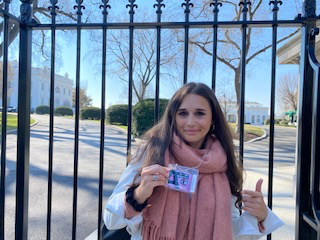
What a three weeks: Meeting with former Congressman Charlie Dent, visiting Bloomberg, lunch at Katz Deli, background talk with EU Ambassador to the United Nations Olof Skoog and coffee with Donald Trump’s ex-lawyer Michael Cohen. And that’s just a small sample. We were able to meet over 35 people from a wide variety of backgrounds during that time – including a visit to Broadway and a boat trip on the Hudson River. My personal highlights: the visit to the White House (see photo), the church service in Harlem and a lunch with the founder of Black Live Matters New York, Chivona Newsome, in the Harlem district of New York.
Prior to the trip, I had hoped to gain insight into a wide variety of areas and learn more about the American perspective on major contemporary issues. At that time, I did not know that the current topic would be the Ukraine war. A week before the trip began, Putin’s troops invaded Ukraine. And German-American relations suddenly became closer than they had been for a long time. Whether it would stay that way, how the new German government would be received in the U.S., and what could help to stop Putin were all questions we had more than once during the course of the trip.
On the one hand, the many conversations gave hope about the fact that the West is just moving together so cohesively, but also left many question marks about how long that will last. Regardless of the international issues, the many appointments also showed how torn the USA is. There were no answers as to how this can be solved with a two-party system. What remains are many new contacts and an insight into the USA that I would not have had without RIAS.
——————–
Okka Gundel, ARD Tagesthemen
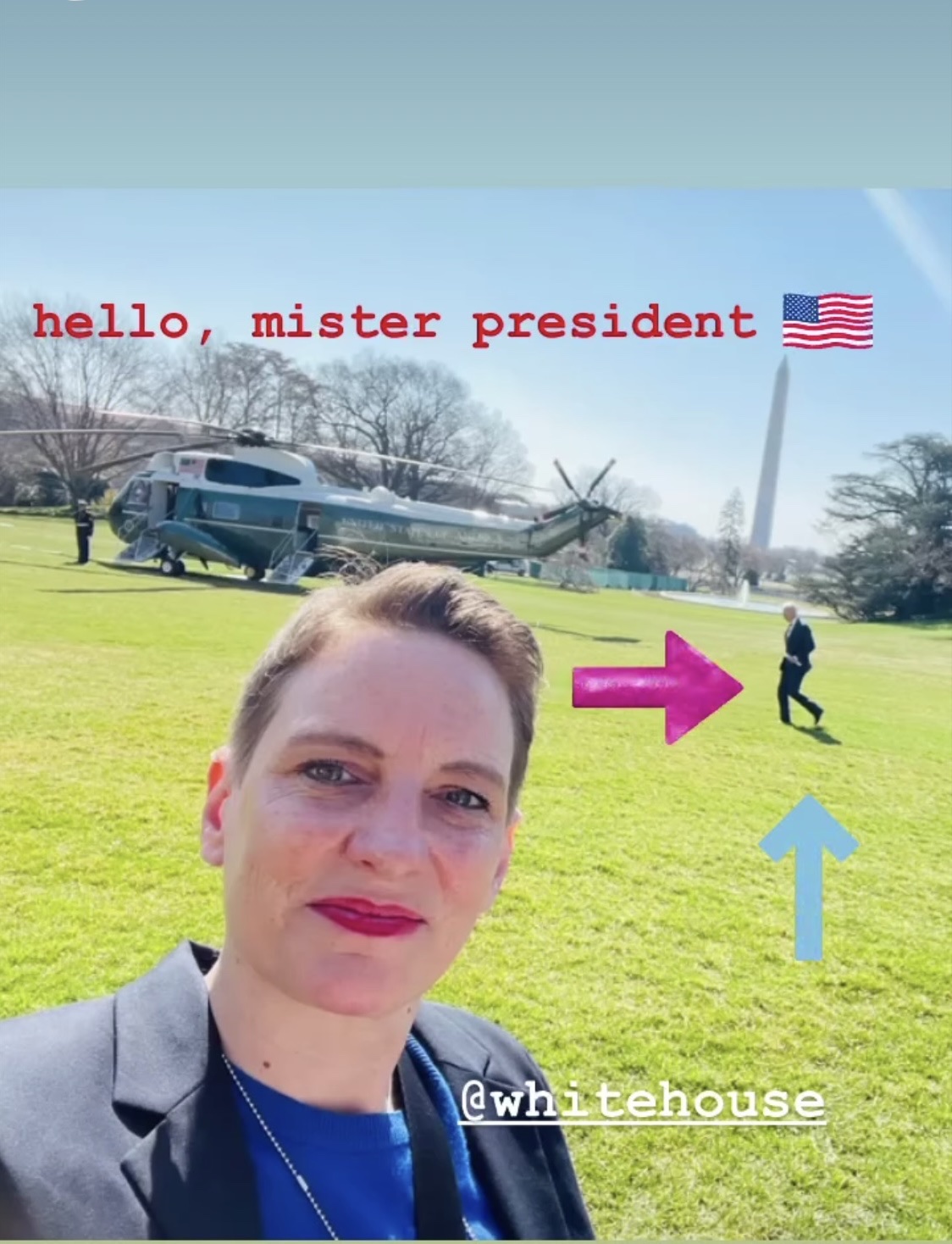
America First? No. First Time America. At least for me. My first time in the USA. At the age of 47. Thanks to the RIAS program, it was a privileged, exclusive, and fabulous first glimpse of this country. Unique! My feeling for this country is similar to the American society itself. Divided. Inspiring and disturbing at the same time. United States that is anything but united. A democracy that doesn’t seem to be a real democracy. Beautiful Washington. Dazzling New York. Plain Texas. Many of our influential, impressive interviewees had a pessimistic view of their homeland. By contrast, the grassroots I was privileged to encounter in many Uber rides through the Texas metropolitan area of San Antonio struck me as surprisingly optimistic and content. Upside-down world. A world that is so modern and progressive on the one hand and so backward on the other. While here in Germany we have to fear that the garbage will not be picked up because the wrong item ends up in the wrong garbage can, in the U.S. the throwaway society happily lives on. In the hotel, every single piece of cutlery is shrink-wrapped in plastic, and on the streets SUVs and pickup trucks are used for every little journey. Mother Earth – I am perplexed and worried about you! More than ever. I had also been worried beforehand about whether I would be able to stand two weeks in a group. A class trip with classmates and teachers I didn’t know. Unnecessary. I enjoyed the campfire atmosphere. Very much so. When I suddenly found myself alone in San Antonio after a very intense time in human community, I felt a kind of phantom pain. I missed my group. Thank you RIAS for all the impulses. For the profound ones, the lively ones and the thoughtful ones. Thank you for a very special experience. Content and interpersonal.
My station week in San Antonio, Texas. After the fast-paced and exciting time in Washington and New York, everything seemed very slow and unexciting. A bit of a culture shock. My host, Yami Virgin, is a dazzling personality and an excellent investigative TV reporter. One afternoon, Yami sent me via Uber to a baseball stadium on the prairie. There I met her station’s sports reporter. A very pleasant blind date. At first, Chuck tried to explain the rules of baseball to me. But soon we digressed to his life as an American and mine as a European. A profound encounter in the setting of a high school baseball duel. Every night we were out to dinner. Yami and me. And at least one of her friends or colleagues. Somewhere in the middle of nowhere, at unadorned truck stops along the highways, wonderful restaurants hid night after night. It was interesting and gave me a feel for the way of life there. After the “sensory overload” of Washington and New York, Texas was altogether disillusioning. And yet so enriching. Within three weeks I was able to experience a large keyboard of us-American culture. The truth may lie somewhere in between.
——————–
Andreas Büttner, Welt TV
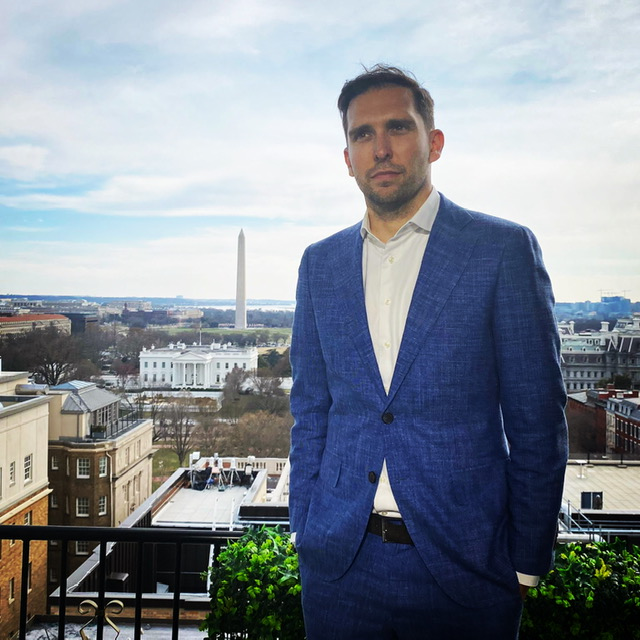
I applied three years ago, but the last two years were cancelled because of Covid, and now it finally worked out: The RIAS USA Journalism Program. Due to the long wait, the anticipation was now even greater and it was also a good thing that we could participate in this program only now. So we spontaneously had the chance to visit the White House and to watch US President Biden taking off with his Marine One. For me the absolute highlight of this trip! Or the church service in Harlem, which was on the official program for the first time and where the gospel choir blew us away just as much as the president’s helicopter.
Every day new appointments with personalities like Michael Cohen, former lawyer of US President Trump. Every day interesting stories, like that of Frieda Vizel, a dropout from the Hasidic Jewish community in Williamsburg. Every day great conversations with correspondents from Spiegel, ZDF and Deutsche Welle. Of course, the best view of the White House was provided by WELT, where the colleagues from the public broadcaster could learn a thing or two (see photo).I would like to thank RIAS for this unforgettable program, the life-changing experiences and the wonderful group full of great people with whom I was able to complete this trip.
Station Week Los Angeles: I had the great honor of completing my Station Week with Frank Mottek, “The Voice of Business News in Los Angeles.” On my first day, I was a guest on his radio show “Mottek On Money” on KABC. There I talked about the German perspective on the Ukraine war, rising gasoline prices and the new Tesla Gigafactory. My first appearance in English, an exciting experience. I also met a TV journalist from KTLA, who was in Ukraine until recently, and the fire department from Berlin, who paid tribute to the late L.A. County mayor and friend of the fire department at a memorial service. On my last day, I was allowed to be a journalist on the red carpet of the Irish Oscar party in Hollywood. There I helped out an American colleague as a cameraman because he had problems with the tripod. German-American understanding in journalism, which would never have been possible without RIAS!
——————–
Sven Christian, Spiegel Video
The first time in 15 years I had to wear a tie again. Lost bet. But the occasion was more than appropriate: We were allowed to visit the White House, look behind the scenes and see the president at least from afar. We met hardliners in think tanks, discussed with woken journalists and activists, and were spiritually enchanted by a church service in Harlem.
This trip exceeded all my expectations. In terms of content, one highlight chased the next. But it was often the supposedly less spectacular meetings that moved me the most. The one with the quietly accomplished correspondent Jeff Mason, who ushered us into the White House. With Bill Whitaker, who told us about smart TV journalism. With BLM founder Chivona Newsome, who didn’t become an angry citizen despite systematic oppression. To name just a few. All this gives us courage to continue reporting well, honestly and fairly. We have noticed in many conversations that this is more necessary than ever before.
——————–
Nadine Bader, ARD
Being overshadowed by Russia’s war in Ukraine, the RIAS program im March 2022 excelled at profound talks about international politics and about the importance of transatlantic relations. Arguing with a fellow from conservative Hudson Institute about whether NATO has underestimated the importance of deterrence is just one example.Meeting with an expert from Brookings Institution gave us more insight into internal policies, Congress and its role in solving staggering policy problems such es economic inequality and structural racism.Numerous talks with US journalists enabled us to gain better understanding of US media markets. These meetings also gave deeper insight into how German politics (for example the long resistance to halt Nord Stream 2) are perceived in the US. Discussions with German correspondents completed this outstanding program. One of the many highlights certainly was the visit to the White House.
Besides all these profound talks in Washington DC and New York, our visit to the Big Apple provided an insight into the diversity of this breathtaking city. Meeting with Chivona Newsome, cofounder of Black Lives Matter Greater New York, is just one example. My highlight by far was our tour with Frieda Vizel in the Satmar Hasidic community in Jewish Brooklyn. The station week in Sioux Falls with Dakota News Now rounded off my RIAS-experience. The editorial team was very welcoming and open-minded. They showed me how they produce several hours of news broadcast per day. For instance, I accompanied a reporter doing a package on the upcoming mayoral elections. On my last day, I even met polarizing South Dakota Governor Kristi Noem at a press conference about cyber security. Unfortunately I didn’t get a chance to ask her, why she wants to ban Critical Race Theory at all schools and universities in the state. Next time! Overall, the RIAS program in Washington DC, New York and Sioux Falls gave me a deep insight into the diverse and partly polarized US society. Thank you!
——————–
Theresa Greim, Bayerischer Rundfunk
How many high-level, diverse and in-depth background discussions can you manage in nine days? To make a long story short: More than 35. (That’s not counting the many sightseeing highlights.) I wouldn’t have thought it possible to gain so many new and, above all, enriching insights in such a short time. In my journalistic work, I deal with U.S. topics almost every day, but no reportage, no background report or correspondent talk can even come close to what the encounters in these one and a half weeks of RIAS program achieved: To gain a deeper understanding of what moves people in the U.S., how they see themselves, what conflicts, values and visions drive them, and also how the U.S. perceives Germany and Europe. I was particularly surprised by the openness of our interlocutors. Almost all of the conversations were a genuine, open dialogue. I was also impressed by how warmly and enthusiastically the U.S. RIAS alumni looked after us. Whether at the graduation ceremonies in Washington and New York or during my Station Week in Boston – I always felt welcome and look forward to continuing to cultivate these valuable new contacts in the future. Or to put it in the words of Washington DC Alumni Chapter Leader Larry Mill er: You’re family now.
Station Week Boston: My RIAS host in Bo ston, Yasmin Amer, gave me a warm welcome. Although newsroom work continues to be hampered by Corona and most seats at WBUR are orphaned, Yasmin did her best to show me as much as possible. This included the morning 9 a.m. conference, plus the meeting for the Boston radio show; I was then able to watch the results of the issues being implemented live in the studio. I got to be part of the planning and preparation for the nationally broadcast show “Here and Now”, and also got to watch the show live in the studio. Yasmin took me to pitch a new podcast idea. I also got to talk at length with and look over the shoulder of the newsroom and News Anchor, which, being a news anchor myself, I was especially excited about. Yasmin also gave me a tour of Harvard, where she participated in the Nieman Fellowship last year/year before last. We also talked about similarities and differences in our work. Yasmin is very open and gave me many interesting insights into the work of a radio station on the US East Coast. Some colleagues at WBUR have shown great interest in joining the RIAS program in Germany. Yasmin’s response was always, “You really should do it. It’s great.”
——————–
Erik Kirschbaum, Executive Director RIAS Berlin
Seeing the United States through the eyes of German journalists – some of whom have never been to Washington or New York before – is always a special treat for me as the executive director of the RIAS Berlin Commission. Even after six years, 12 programs and accompanying more than 150 German journalists to the USA, there are always new discoveries and experiences to make. It’s their incurable curiosity, their insatiable appetite to learn more about the country that for good or worse plays such an oversize role in their lives and their healthy skepticism of the American way of life (the ubiquitous ‘disposable plastic’ mentality is a massive culture shock for visitors from Germany every time) that makes it a joy, and honor, to lead groups of 10 to 15 Germans around Washington and New York for two weeks twice each year. The two weeks in Washington and NY are always packed full with meetings before many of them depart for a third week on their own visiting a small American radio or TV station in the Midwest or Southwest to see another side of America. It’s a demanding and exhausting schedule of up to five meetings/dinner talks each day. But who could say no to a last-minute offer to visit the White House press room? Or would anyone want to turn down an opportunity to see a gospel choir perform at a stirring church service in Harlem? Every group is different. Every group presents new challenges. Every group has a different program schedule. Thanks to our American alumni Adam Reiss, Tiffany Zeno and Michael Gargiulo and support from Jeff Mason and Larry Miller in Washington, the March 2022 group had the best and busiest program ever – and I was lucky enough to be along for the ride.


